“What we love, we protect. What we heal, we become.” Those lines open and close our song “Love the Land,” and the chant in the middle is just as simple: love the land, love the water, be the change. It is easy to hear that as a mood. This post is about the mechanism behind it, because on Hawaiʻi Island the land and the reef are connected in a way you can measure.
The reef gets what the ground lets through
When people hear “cesspool,” they think of germs. The Department of Health lists those too: bacteria, protozoa and viruses linked to illnesses such as gastroenteritis, hepatitis A and leptospirosis. But wastewater also carries nutrients, and the DOH says they promote algae growth.
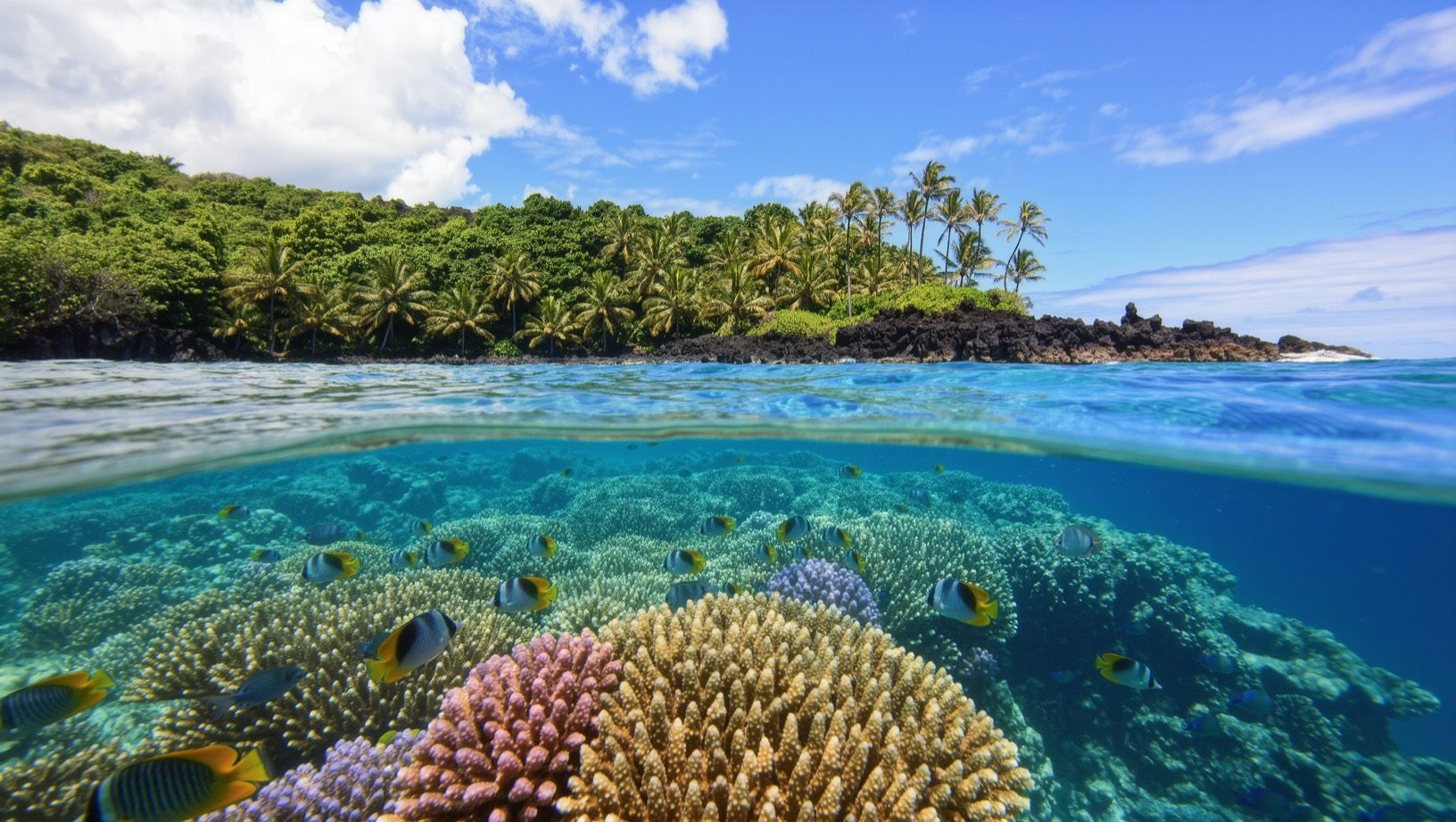
That matters for coral. Algae and coral compete for the same hard, sunlit surfaces, and a reef that gets a steady supply of nutrients from the land can slowly tip toward algae. You cannot see it happening. The water can look clear while it does.
Hawaiʻi has about 83,000 cesspools, about 48,600 on Hawaiʻi Island, and the island’s cesspools release an estimated 29 million gallons a day into the ground. On young, porous lava rock, that water does not stay put.
- fastest dye-tracer trip from a home to the shoreline at Puakō (UH Hilo, 2021)
- 6 hours
- fastest dye-tracer trip from a home to the shoreline at Puakō (UH Hilo, 2021)
- of sampled Puakō homes had water out front above the State’s swimming standard for bacteria (UH Hilo, 2021)
- 81%
- of sampled Puakō homes had water out front above the State’s swimming standard for bacteria (UH Hilo, 2021)
- of the sampled area would still fail the standard even if every home upgraded, without a treatment plant (UH Hilo, 2021)
- 69%
- of the sampled area would still fail the standard even if every home upgraded, without a treatment plant (UH Hilo, 2021)
What the researchers found
At Puakō, UH Hilo marine scientists Tracy Wiegner and Steve Colbert put dye into home wastewater systems and watched the shoreline. It appeared in as little as six hours. Bacteria in the water in front of 81 percent of the homes they sampled exceeded the State’s standards for recreational water. Colbert’s summary: “it’s not the kind of water that I would want to be swimming in.”
They also found something uncomfortable. Even if every resident replaced a cesspool with a newer system, they estimated 69 percent of the sampled area would still fail State water quality standards without a treatment plant, and they concluded a community plant at Puakō would be best for water quality and reef health. Putting a better tank in every yard may not be enough in every place. Geology and housing density decide that.
The reef itself was studied too. A 2023 paper in the journal *Marine Pollution Bulletin*, by a team from UH Hilo, UH Mānoa, NOAA and the State’s Division of Aquatic Resources, tested the water and surveyed the reef at Puakō in 2018 and 2019. It found moderate sewage pollution on the offshore reef, coming from seeps on the seafloor, diluted by water motion. The authors believe those conditions likely contribute to the dominance of turf algae and to growth anomalies and algal overgrowth on corals. They stop short of saying sewage is the only cause.
It is not only Puakō. In August 2024, a UH Hilo dye test at a home near Kahaluʻu Beach Park in Kona showed dye emerging at a shoreline spring, and the team estimated that homes with cesspools near Aliʻi Drive could send sewage to the shore in under six hours. In Keaukaha, near Hilo, a 2025 study confirmed wastewater reaching coastal waters and reefs.
The land does not stop at the shoreline. Neither does what we put in it.
Leave it more alive than you found it
The song’s quiet middle section says: “Take only what you need. Give back more than you take. Leave this place more alive than you found it.” For a homeowner, the biggest single thing that sentence can mean is what happens to your wastewater.
State law requires every cesspool in Hawaiʻi to be upgraded, converted or connected to sewer by 2050. A replacement puts a treatment system between the house and the ground, so the water is treated before it goes back in. The first step is to know where you stand: whether you have a cesspool, how close you are to the ocean, and how deep the groundwater is. Start My Property Check shows those, free, in about a minute.
ʻĀina Force does not engineer or build anything. Licensed independent engineers and contractors do that, and DOH approves. We help people through it. If you want the broader picture of how wastewater travels to the sea, read Is Hawaiʻi’s ocean full of sewage?