For the keiki
Kai and the Big Backyard Dig
A free picture book to read together before the crew arrives. Kai the honu explains what a cesspool is, where the water goes when you flush, and who all those people in the backyard are. Ages about 3 to 8.
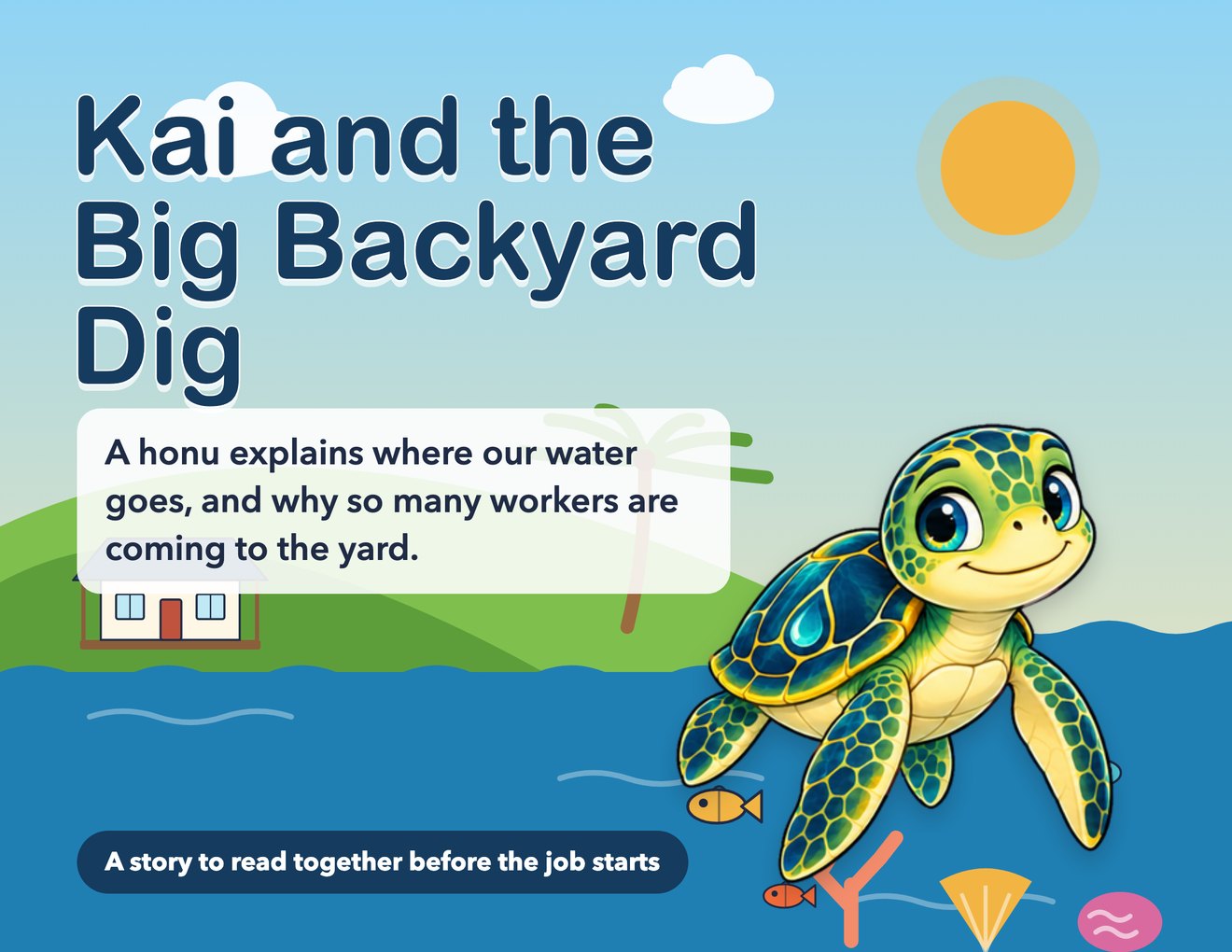
Read together
Nineteen pages, about ten minutes at bedtime.
Big pictures, short lines, and a page of Kai’s rules for staying safe while the machines are in the yard.
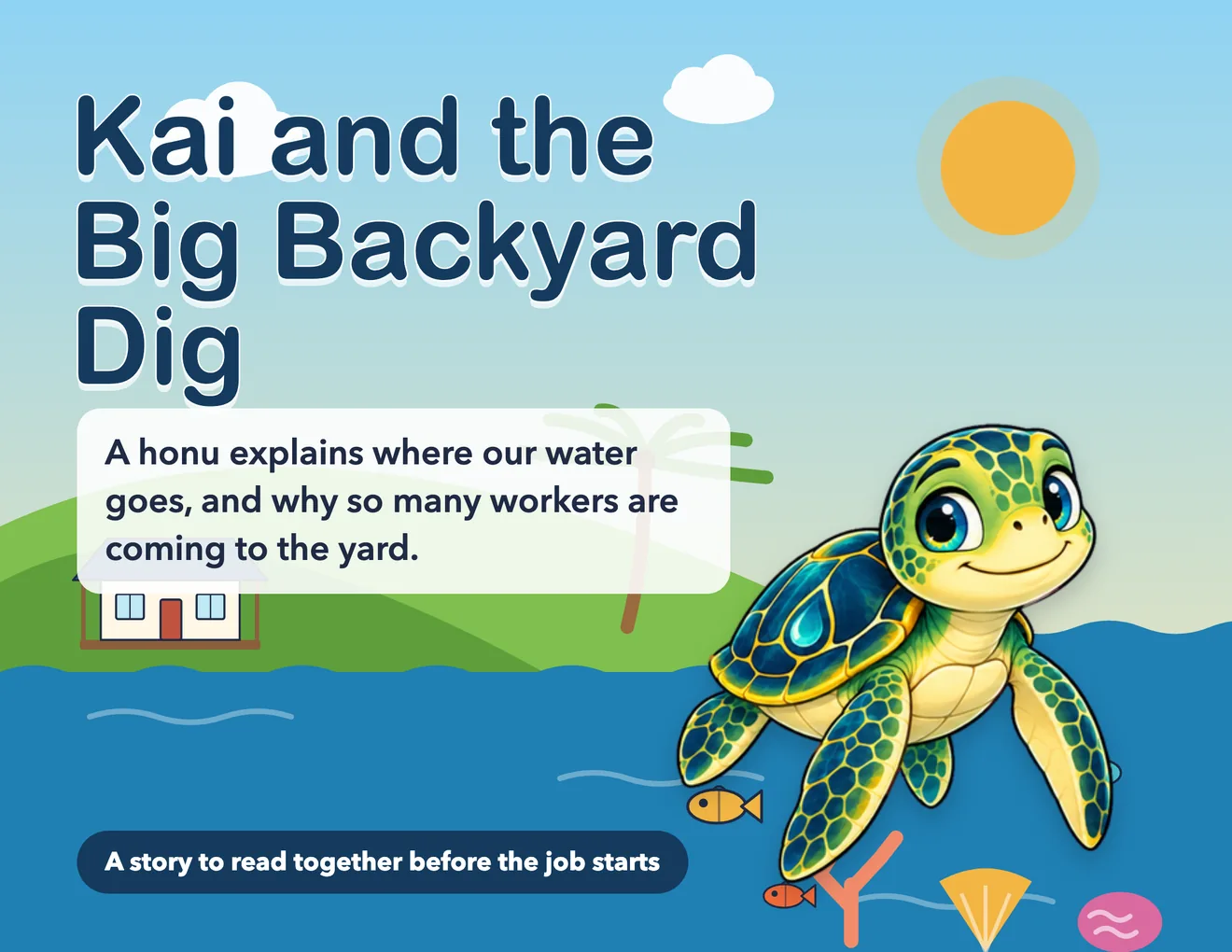
Cover · 1 of 19
Use the arrows, your keyboard, or swipe.

For the grown-ups
What the book says, and why.
Hawaiʻi Island has about 48,600 cesspools, more than half of all the cesspools in the State, and together they send about 29 million gallons of untreated wastewater into the ground every day. State law says every one must be upgraded, converted, or connected to a sewer by 2050. A conversion puts a treatment system between the house and the ground, so the water is cleaned before it reaches the aquifer and the sea.
The story follows the real sequence for an on-site system: a licensed engineer evaluates the site and designs it, the Department of Health approves the plans, a licensed contractor builds it and closes the old cesspool, the engineer inspects before backfill and reports to DOH, and DOH issues the written approval to use. Where a sewer line is available, the house is connected to the sewer instead, and there is no tank.
Not every job has every worker. Some crews do the plumbing themselves, and the electrician only comes when the tank has an air pump. The “Who’s in my yard?” list is there so you can tick off the ones you actually meet.
Things to talk about together
Where is makai from our house? Which worker did we see today, and what was their job? What do we do when the machine is moving? Why does the yard look brown right now?
Printing it
- Letter paper, landscape. The pages are 11 by 8.5 inches, so choose “landscape” in the print box.
- For a real book, print double-sided and flip on the short edge, then staple down the left side or punch two holes and tie with ribbon.
- For a quicker version, print single-sided and keep the pages in a folder, or just read it on a tablet.
Who’s in my yard?
Check them off as they come.
- Engineer reads the ground, draws the plan, takes the photos, writes the final report.
- Department of Health says yes to the plan, and yes again at the very end.
- Excavator operator digs the hole and the trenches, then puts the dirt back.
- Delivery driver brings the tank, the gravel and the pipe.
- Plumber joins the house pipes to the new tank.
- Electrician wires the air pump, if the tank has one.
- Pump truck empties the old cesspool before it is filled in.
Kai’s Hawaiian words
- ʻāina
- — the land
- kai
- — the sea
- wai
- — fresh water
- honu
- — green sea turtle
- keiki
- — child
- ʻohana
- — family
- mauka
- — toward the mountain
- makai
- — toward the sea
- mālama
- — to care for
- kuleana
- — responsibility
- lānai
- — porch
- pau
- — finished
- mahalo
- — thank you
- aloha
- — hello, love
Not sure where your own yard stands?
The free property check shows your parcel and its State priority area, and we’ll follow up about what a conversion may involve.
ʻĀina Force helps homeowners navigate cesspool conversion by coordinating information, introductions, documentation, and communication. Engineering, permitting, installation, and inspections are performed under separate agreements by appropriately licensed independent professionals and contractors. Facts in the book come from the State of Hawaiʻi Department of Health and HRS §342D-72. Kai is ʻĀina Force’s honu. The book may be printed and shared freely with families, schools, and community groups.