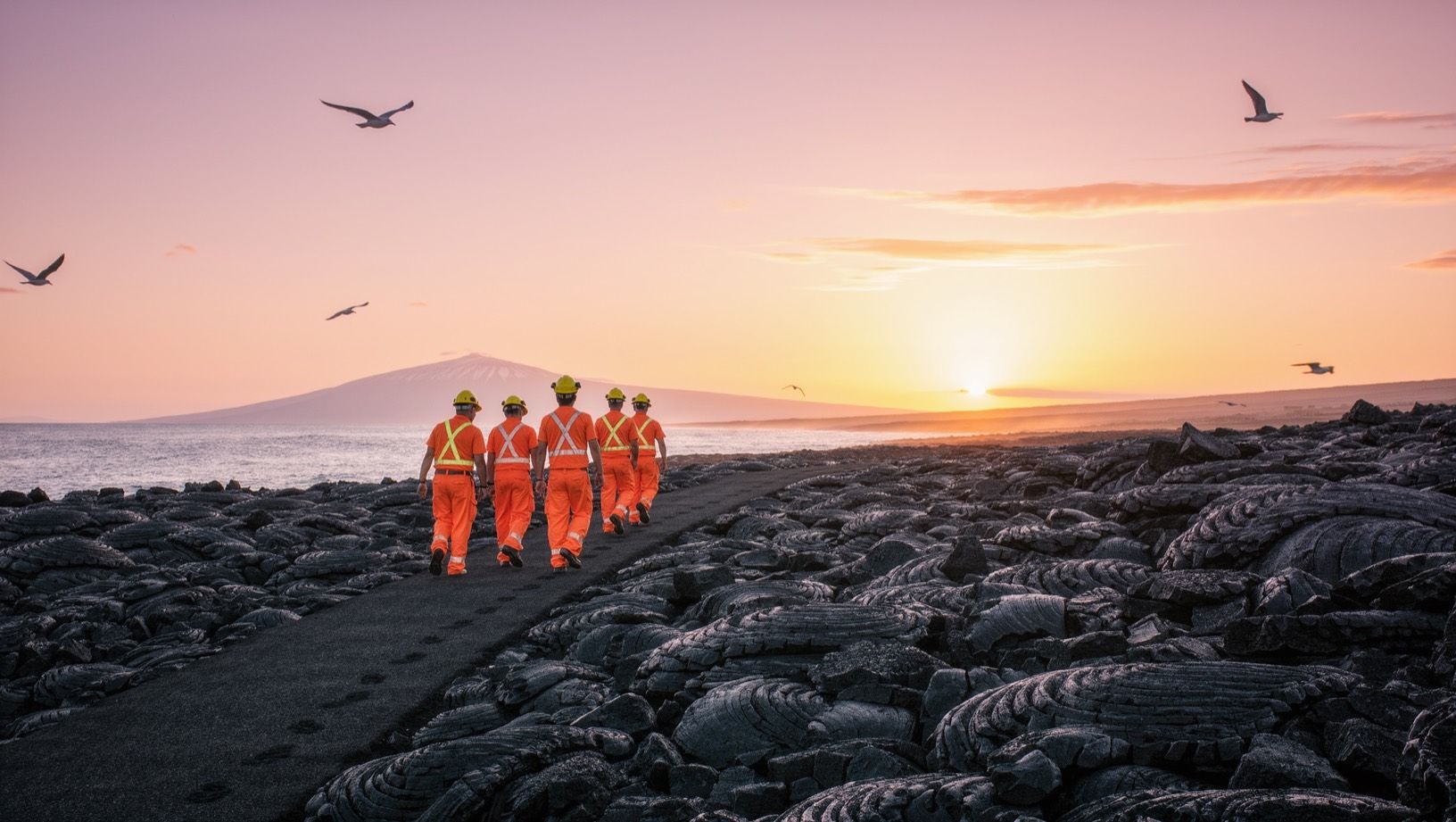
Our song “What a blessing” starts with a sunrise and ends at the work. “Work boots waiting by the doorway, now the crew is on the road.” It is a song about showing up, and about the fact that a project like replacing a cesspool is never one person’s job.
A word about “crew,” because it matters. ʻĀina Force does not dig, design or build. The people who do that are licensed professionals who work independently of us. When the song says “we listen first, then make a plan, bring the right people, hand in hand,” that describes our job: the listening, the planning and the introductions.
A relay, not a single job
The State’s homeowner process for an individual wastewater system runs in a fixed order: a licensed engineer evaluates the site, the Department of Health reviews the plans, a licensed contractor builds the system and closes the old cesspool, the engineer inspects the work and reports to DOH, and DOH issues the approval to use.
- Engineer
- DOH review
- Contractor
- Engineer inspects
- DOH approval
Each of those people is good at one thing. The engineer is a Hawaiʻi-licensed civil engineer who reads the ground: lot size, soil depth, how fast water drains in a test hole, and how far the property is from wells, streams and the shoreline. DOH’s Wastewater Branch checks the plans, and its own guidance says review can take about two days to two weeks, depending mostly on how complete the paperwork is. The contractor must hold one of the license classes DOH accepts, and a plumber or electrician may join the job when the design calls for it. When the work is done, the engineer inspects it and reports to DOH within 30 days.
None of these steps is especially long on its own. The time goes missing in the handoffs.
Where it slows down
From the outside, a conversion looks like a hole in the yard. From the inside, it is a stack of waiting: the engineer’s calendar, the completeness of the DOH submittal, the contractor’s schedule, and getting the inspection done before the trench is backfilled. A form that sat in an inbox, or a crew that could not start because approval had not been forwarded, can add weeks without anyone doing anything wrong.
Scale makes this matter. Hawaiʻi has about 83,000 cesspools, about 48,600 of them on Hawaiʻi Island, and every one must be upgraded, converted or connected to sewer by 2050. Statewide, roughly 400 cesspools a year have been converted, which at that pace would take more than 200 years. The State will not reach 2050 by each family figuring out the process alone.
What we do, and what we don’t
We coordinate. In practice that means being the one place a homeowner can ask “where are we?” and get a straight answer, and helping keep documents, introductions and follow-ups moving between the engineer, DOH and the contractor.
- We do not engineer, permit or build anything.
- We do not quote prices or promise funding. Hawaiʻi County estimates an on-site conversion at $30,000 to $70,000, and the new State loan fund is still being set up.
- We do not replace the licensed professionals the State requires.
The song’s chorus is a sunrise and a purpose: “For the people and the place that carry me.” The people it means include the engineer who walks your lot at seven in the morning, the plan reviewer at DOH, and the crew with the excavator. We think the work is worth being grateful for.
To see where your own property stands, Start My Property Check. For the long version of this process, read What actually happens when you replace a cesspool?